In the Room Where it Happened
A few days ago I shared a social media post about the mixed emotions of going through old memory boxes. What I didn’t say is that one photograph brought back a memory I have spent a lifetime tiptoeing around.
I have never spoken about it. Not to friends. Not to family. Not even to my therapist. To share feels like a confession of my complete failure.
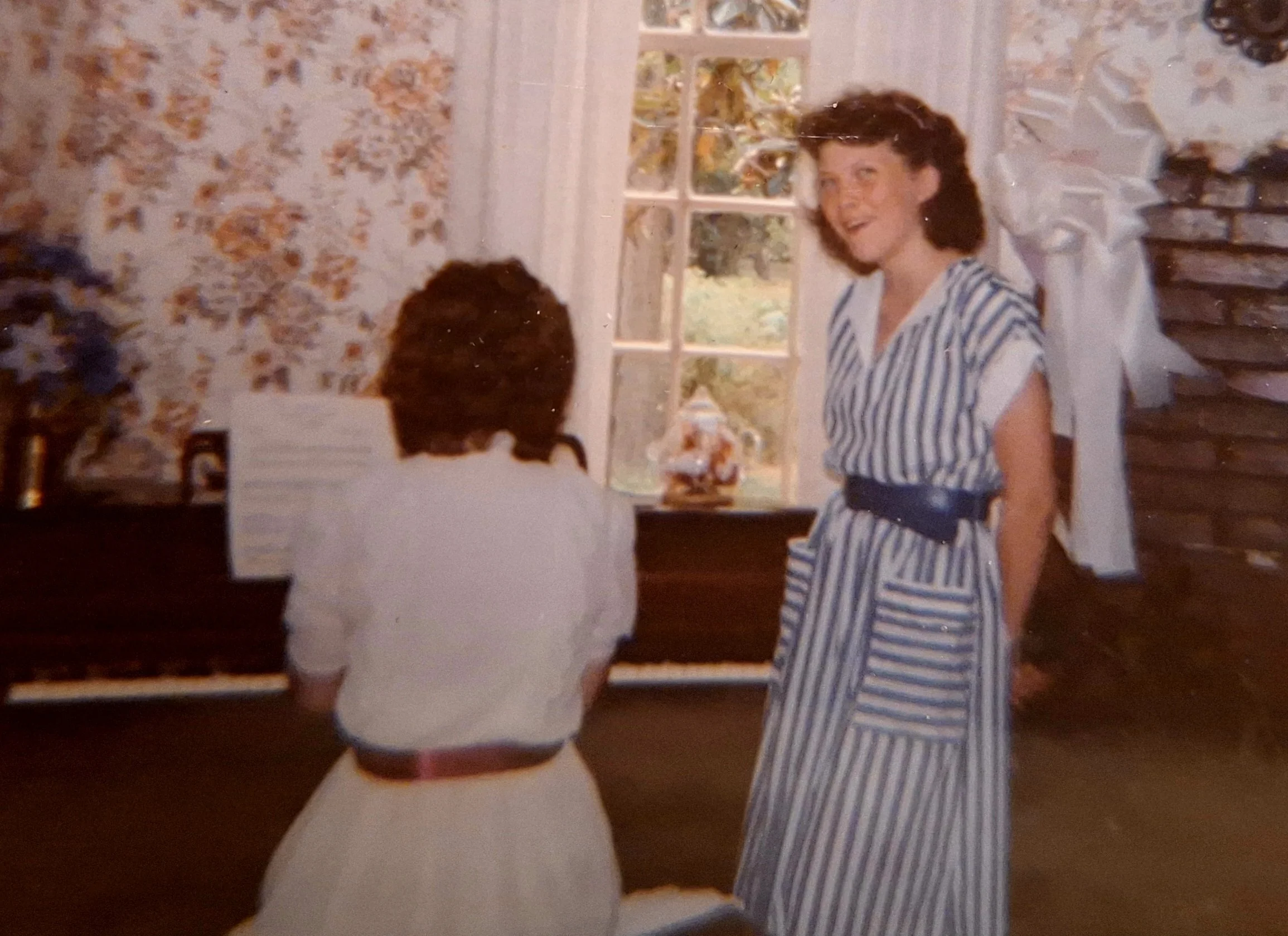
But after staring at that picture for a long time, I realized something: the girl in the blue striped dress deserves a voice far beyond what this snapshot captured. Because next to her—just out of frame—is an abuser. And in front of her is a woman and her two children, walking straight into his arms.
A warning:
(1) If you are in my personal circles, this is a moment of deep sharing. If TMI is something you’d rather not know about this suburban hockey mom, you may want to skip this one.
(2) If you are triggered by stories of childhood abuse, be gentle with yourself if you choose to keep reading.
I’ll describe this scene in greater detail. We are in my aunt's parlor room. The piano you see in the picture is the one I taught myself to play on. In front of me, out of the camera’s view, are a few rows of chairs. We’re gathered for a family wedding, and I am singing the processional music. To the left is my dad, standing as the officiant, and my cousin. The mood in the room is jovial, relaxed. Oddly, I remember the timbre of their voices. The men in my family of origin had voices like warm molasses, seductive and lazy with a hint of humor teasing at every word.
I want to tell you about my cousin — the one you can’t see in this picture — the handsome one smiling and waiting for his bride. He had a drawer full of stuffed animals, the small ones you could get at a fair. And when I was five or six, he gave me one. Not as a gift, but as a way to manipulate me into something no child should ever be asked to give. In the years that followed, he cornered me repeatedly, whispering things in my ear that confused and unsettled me. By the time I put on that blue-striped dress to sing at his wedding, I hated him — and I felt drawn into his orbit. When he ignored me, I felt invisible. When he saw me, I felt threatened. I was well into my adulthood before I understood the concept of grooming or the complexity of the emotions I felt towards him.
And here’s the thing. Everyone in the room that day knew he was a predator. In fact, he wasn’t the only predator there. My uncles were there. Other cousins. And I knew that they all knew. I knew that when I was in that house it was my responsibility to sidestep unwanted — shall we call it — “attention.” I had been instructed by other adults to know it was my responsibility to avoid being in a room alone with him.
Years later when I confronted him. I asked him why. The first thing he said to me was: “I only did what was done to me.” And there you have it—in case those words ring a bell—the title of the third and the last installment of the Ruth Trilogy.
Let’s return to that wedding day, because it is permanently imprinted in my memory. I was watching the bride walk down the makeshift aisle. She was tall and thin with bright red hair and a toothy, easy smile. This was her second marriage, and she had two small children. Inside my pre-pubescent mind, I was screaming, don’t marry him. I wanted to tell her that the person she was committing to might hurt her children. I wondered if he might hurt her. I was singing some sweet song I had been told to sing, and I hated every single word. I tried to make my tone take on the shape of danger. I wanted to ask my parents—my uncle—if she knew. But I’d already been silenced once regarding my cousin.
The little girl in this picture is a coward. An enabler. A keeper of secrets. And she let another woman and her two children walk straight toward danger without saying a word. She’s as guilty as the rest of them.
That is what I see when I look at this picture. And the reason I remember it so well is because I hated myself. The girl in this picture wanted desperately to protect them. She wanted to warn, to intervene, to save. But she had no voice. No power. No safety. No permission to speak. She was told to sing. Shame burned into my bones that day. I remember a nauseous tugging in my chest when my dad asked if anyone objected. He would hurt her children. I object! The two words bounced against my skull never finding their way out, and to this day when I sit at a wedding, this part of the ceremony makes me squirm with discomfort.
I saw this picture for the first time in a long time last week. And I’m going to be completely honest with you — because this is how childhood trauma writes itself into our story — I felt angry at her. Her cowardice. I felt ashamed of her.
Until slowly, the adult in me began to rise. Began to object. Began to see clearly a moment when that child felt the full burden of systemic abuse, and the weight of it silenced her. Her silence wasn’t failure or cowardice — it was a survival strategy. And it is so insanely hard to describe within the bounds of words, but I felt a righteous anger rise in me for her. She could not speak for herself or for those two children that worried her or the children who worry her still.
In my mind, I circled the room, trying to recall the faces there. The grown-ups. The ones who did have power. The ones who not once held anyone accountable, but instead put their fingers to their lips and said, don’t tell.
This little girl stands in silence at the center of a writing project that has claimed seven years of my creative energy. The books are about my grandmother—my mother—all the women spiralling out from them, but I realized this girl has been with me all along too. This girl who wanted to speak up, but instead swallowed her voice and carried a guilt that still resonates forty years later. Sugarcane Saint, Sipping Mercury, and What Was Done to Me explore a lineage of silence—one which led to that little girl standing in a parlor, looking into the eyes of another woman and wanting to warn her, wishing she could tell her the truth.
She had no power then.
But her voice—My Voice—has grown Stronger. Louder. Freer.
And even if using it is uncomfortable—even awkward and often painful—I will not let that little girl in the blue striped dress carry this alone anymore. I will not ask her to sing sweetly when what she really wants to do is shout.
She could not speak in that room.
But I can.
If reading this resonates for you or with someone you know, please know you are not alone. Don’t sweep it away. Seek help, support, and counsel. It is okay to reach for out for help:
>Private counseling: Resources like Talkspace often accept health insurance.
>RAINN (Rape, Abuse & Incest National Network): https://www.rainn.org | 1‑800‑656‑4673
>Childhelp (Child Abuse Hotline): https://www.childhelp.org | 1‑800‑422‑4453
>National Sexual Violence Resource Center: https://www.nsvrc.org
Because every child — even the one inside you — deserves a voice.
Join my reader list and you’ll be the first to know when new work is on the way—sometimes even before it’s finished. You’ll also get access to special pricing just for readers who’ve been here from the beginning. No pressure, no clutter. Just quiet notes, early pages, and the occasional thank-you.